Pallipallisell Singapore Property Selling Explained for 2026


Most Singaporean property owners believe selling without an agent means navigating a maze of paperwork alone, risking costly mistakes, and ultimately losing more than they save. That belief is costing sellers real money. Pallipallisell Singapore property selling explained simply means this: you list your property, communicate directly with buyers, negotiate on your own terms, and pay a flat fee of S$688 instead of handing over 1% to 2% of your sale price in agent commissions. This guide walks you through every step of that process, the costs you need to plan for, and the key differences between selling an HDB flat and a private home.
Table of Contents
Key Takeaways
Point | Details |
Agent commissions are avoidable | Selling directly saves 1–2% of your sale price, often tens of thousands of dollars. |
HDB sales follow a strict sequence | You must register an Intent to Sell on the HDB Resale Portal before listing your flat. |
CPF refunds reduce cash proceeds | CPF funds used for purchase must be returned with 2.5% accrued interest upon sale. |
SSD applies to private property | Seller’s Stamp Duty rates range from 12% down to 0% depending on your holding period. |
Fixed-fee platforms change the math | Pallipallisell’s flat S$688 fee gives sellers full control without the commission burden. |
How Pallipallisell Singapore property selling works step by step
Whether you own an HDB flat in Tampines or a condominium in River Valley, the selling process follows a clear sequence. Knowing each step in advance removes the anxiety and keeps your timeline on track.
For HDB flat sellers, follow these steps:
Register your Intent to Sell on the HDB Resale Portal. This registration is valid for 12 months and is mandatory before you can market your flat. The HDB resale process takes approximately 8 weeks from application to completion, so plan your finances early.
List your property on Pallipallisell. Upload photos, set your asking price, and publish your listing. Buyers contact you directly through the platform.
Negotiate and agree on price. You speak to buyers without a middleman. You decide what to accept.
Grant the Option to Purchase (OTP). Once price is agreed, you issue the OTP. The buyer pays an option fee, typically 1% of the purchase price. They then have 21 days to exercise the option.
Submit the joint resale application on the HDB Resale Portal. Both buyer and seller submit within 7 days of each other. HDB then assesses eligibility, CPF usage, and housing grants.
Attend the completion appointment. HDB schedules the final appointment, keys are handed over, and ownership transfers officially.
For private property sellers, the process differs slightly:
List on Pallipallisell and market directly to buyers.
Negotiate and issue the OTP. Private property OTPs typically involve a 1% option fee with a 14-day exercise window.
Sign the Sale and Purchase Agreement (S&P) through your conveyancing lawyer.
Complete the sale. The full process from OTP to legal completion typically takes 10 to 12 weeks for private properties.
Pro Tip: Engage your conveyancing lawyer before you issue the OTP, not after. Your lawyer needs time to review your CPF obligations, outstanding mortgage, and title documents. Late engagement causes delays that can frustrate buyers and push back your cash proceeds.
Costs and legal obligations you need to plan for
Understanding your net proceeds before you list prevents unpleasant surprises at completion. Here is a breakdown of the costs you will likely face.
Key selling costs at a glance
Cost Item | Typical Amount | Notes |
Agent commission (if using agent) | 1–2% of sale price | Eliminated when selling via Pallipallisell |
Pallipallisell fixed fee | S$688 | Flat fee, no percentage commission |
Legal/conveyancing fees | S$2,500 to S$4,000 | For private property; HDB conveyancing is lower |
Seller’s Stamp Duty (SSD) | 12%, 8%, 4%, or 0% | Private property only; depends on holding period |
CPF refund with accrued interest | Varies | 2.5% per annum, compounded annually |
Mortgage early redemption penalty | Varies by bank | Check your loan agreement |
HDB admin and resale fees | S$80 admin fee | Paid to HDB upon resale application |
The biggest surprise for most sellers is not the legal fees. It is the CPF refund. Any CPF funds you used to pay for your property must be refunded with accrued interest at 2.5% per annum, compounded annually. This goes back into your CPF Ordinary Account, not your pocket. Sellers who have owned their property for 10 or more years are often shocked by how much the accrued interest has grown.
For private property sellers, Seller’s Stamp Duty is the other major cost to plan for. SSD rates apply on a sliding scale based on how long you have owned the property: 12% in year one, 8% in year two, 4% in year three, and 0% after four years. Selling in the first two years means combined transaction costs can reach 17 to 18% of your sale price. That is rarely a good financial decision unless your property has appreciated substantially.
Pro Tip: Run your CPF refund calculation using the CPF Board’s online tool before you set your asking price. You need to know your actual cash-in-hand figure, not just your gross sale price, to make informed pricing decisions.
Confirm your outstanding mortgage balance and check for early redemption lock-in periods
Calculate CPF funds used plus accrued interest to date
Factor in legal fees and any property tax proration owed to the buyer
For HDB sellers, check if you owe a resale levy from a previous subsidized flat purchase
HDB flats versus private homes: key differences
The rules for selling an HDB flat and selling a private property are not the same. Sellers who treat them as identical processes make costly errors.
Comparison of HDB vs. private property selling rules
Factor | HDB Flat | Private Property |
Minimum Occupation Period | 5 years MOP required | No MOP restriction |
Seller’s Stamp Duty | Not applicable | Applies within 4 years of purchase |
Resale portal required | Yes, HDB Resale Portal | No; conveyancing handled by lawyers |
Buyer eligibility checks | HDB citizenship and quota rules apply | No quota; buyers are any qualified purchasers |
Resale levy | May apply if buying new subsidized flat after | Not applicable |
Prime/Plus flat restrictions | Extended MOP and subsidy clawback rules | Not applicable |
Typical completion timeline | 8 to 12 weeks from resale application | 10 to 12 weeks from OTP exercise |
One critical update for 2026: new HDB flat classifications including Prime and Plus categories carry extended MOPs beyond the standard 5 years. If you own one of these newer flats, verify your MOP status before you list.
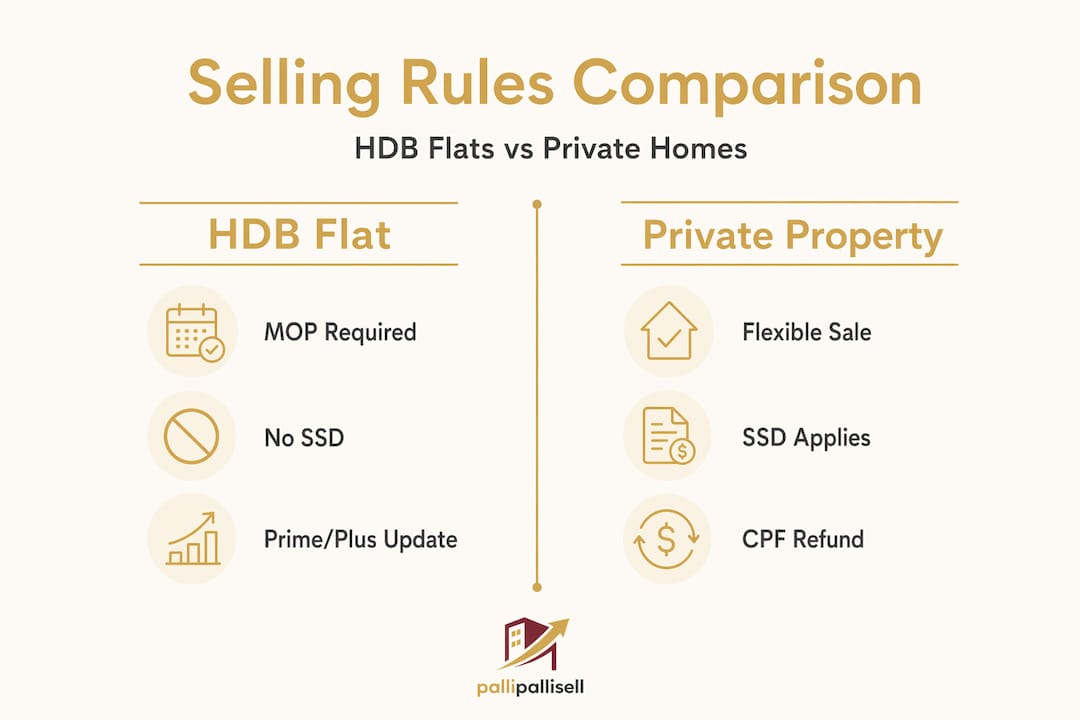
Private property sellers have more flexibility but face SSD exposure if they sell within four years. HDB sellers face no SSD but must navigate buyer eligibility carefully. The ethnic integration quota, for example, limits who can buy your flat based on the existing racial composition in your block and neighborhood. Checking this quota status before marketing saves time and prevents deals from falling through.
Older HDB flats are also worth understanding from a pricing perspective. Older flats with shorter leases still attract strong demand because of location and buyer demographics. Do not automatically underprice an older flat. Research comparable recent transactions on the HDB Resale Portal before setting your price.
Common pitfalls and how to avoid them
Most direct property sales that go wrong share the same root causes. Avoid these and your transaction moves faster and cleaner.
Incorrect pricing is the most common and most costly mistake. Overpricing leaves you with no buyers. Underpricing means you lose money you should have kept. Use recent comparable transactions, not asking prices, to set your number. Pricing errors are among the top seller mistakes and directly impact both your timeline and your net proceeds.
Underestimating CPF accrued interest can turn what looks like a profitable sale into a “negative sale” where your CPF refund exceeds your net cash from the transaction. Always calculate this before agreeing to a price.
Delaying conveyancing lawyer engagement creates a chain of problems. Lawyers need time to coordinate with CPF Board, your bank, and HDB or the Singapore Land Authority. Engage them the moment you decide to sell.
Skipping buyer eligibility checks for HDB flats can result in a signed deal that HDB rejects. Confirm the buyer’s citizenship status, existing property ownership, and whether the ethnic quota in your block allows the transaction.
Missing HDB portal deadlines after the OTP is granted is a serious issue. Both parties must submit the resale application within the required window. The administrative burden of the HDB portal is consistently underestimated by first-time sellers.
“The preparation phase before listing strongly influences both your sale success and your actual cash-flow outcome. Pricing and CPF planning are not administrative tasks. They are the foundation of your entire transaction.”
Pro Tip: Set up a simple spreadsheet before you list. Include your outstanding mortgage balance, total CPF used plus estimated accrued interest, expected legal fees, and your target sale price. This one document will answer 90% of the financial questions you will face during the sale process.
My take on selling Singapore property without an agent in 2026
I have watched the shift in how Singapore sellers think about agent-free property sales over the past few years, and the change is real. More sellers are arriving at the process prepared. They have done the CPF math. They understand what MOP means for their flat. They know the SSD table by heart.
What still catches sellers off guard is the mindset shift required. Most people enter the process focused on commission savings, which is completely valid. Saving 1% to 2% on a S$600,000 HDB flat means keeping S$6,000 to S$12,000 that would otherwise leave your pocket. But the sellers who have the smoothest transactions are the ones who shift from “how do I avoid paying an agent” to “how do I run this process correctly.” That shift changes everything.
The cases I find most instructive are the negative sale scenarios. A seller spends 10 years in a flat, uses substantial CPF funds across the years, and assumes the sale proceeds will land fully in cash. Then they discover the accrued interest has compounded to a significant sum. The property sold. The transaction completed. But the net cash was far less than expected because a large portion went back to CPF. This is not a failure of the direct selling model. It is a failure of preparation. Pallipallisell’s fixed-fee model puts more money in your hands, but only if you know your actual numbers before you commit to a sale price.
The sellers who use platforms like Pallipallisell most effectively treat the FSBO process as a project with clear steps, not a gamble. They engage lawyers early. They price from data. They check buyer eligibility before negotiating. That approach works.
— Brandon
Start selling your property the cost-effective way
Pallipallisell gives you everything you need to sell your HDB flat or private home directly, without paying thousands in agent commissions. The platform’s flat fee of S$688 covers your listing and platform access, and you keep full control of your negotiations and timeline. Check the Pallipallisell fixed-fee pricing to see exactly what you pay and what you get. If you are selling an HDB flat, the dedicated sell HDB without agent page walks you through the process step by step. You can also browse active property listings to see what comparable properties in your area are currently listed for, which helps you price your own property with confidence. Take the first step today.
FAQ
What is Pallipallisell and how does it work?
Pallipallisell is a Singapore-based platform that lets property owners list and sell their HDB flats or private homes directly to buyers without using a real estate agent. Sellers pay a flat fee of S$688 instead of the typical 1% to 2% agent commission.
Can I sell my HDB flat without an agent in Singapore?
Yes, selling an HDB flat without an agent is legal and fully supported by the HDB Resale Portal. You must complete the mandatory Intent to Sell registration and follow the portal’s process, but no agent is required at any stage.
How long does it take to sell a property without an agent in Singapore?
HDB resale transactions typically take 8 to 12 weeks from the resale application submission. Private property sales generally take 10 to 12 weeks from the time the buyer exercises the Option to Purchase.
What is Seller’s Stamp Duty and does it apply to HDB flats?
Seller’s Stamp Duty applies only to private residential properties sold within four years of purchase, at rates of 12%, 8%, 4%, and 0% respectively. HDB flat sales are not subject to SSD.
Do I need to refund my CPF when I sell my property?
Yes. Any CPF funds used to purchase your property must be refunded to your CPF Ordinary Account upon sale, including accrued interest at 2.5% per annum compounded annually. This reduces your net cash proceeds and should be calculated before you set your asking price.
Recommended


Comments