Real estate agent commission in Singapore: home seller's guide


Most Singapore homeowners assume real estate agent commissions are locked in at a set rate. They’re not. Property agent commission in Singapore is not a fixed, regulated rate — it is negotiable and must be documented in a CEA-prescribed Estate Agency Agreement. That single fact can save you tens of thousands of dollars on your home sale. This guide walks you through exactly how commission works, how to negotiate it, what co-broking means for your wallet, and whether skipping the agent altogether makes sense for you.
Table of Contents
Key Takeaways
Point | Details |
Commission is negotiable | No fixed rate exists in Singapore, so always negotiate the agent’s commission and document it clearly. |
Clarify GST treatment | Ensure your commission agreement states whether GST is included or extra to avoid surprises. |
DIY cuts commission cost | Selling your HDB flat without an agent can eliminate commission fees, but requires handling the full process yourself. |
New rules for co-broking | From July 2024, agents are encouraged to collect commission only from their own client, changing how fees are split in co-broking deals. |
Weigh support vs. savings | Consider time, risk, and support needs when choosing between hiring an agent or using a cost-effective DIY or hybrid solution. |
What is real estate agent commission — and who pays it?
Commission is the fee you pay your property agent for successfully completing the sale of your home. It is calculated as a percentage of the final transaction price. A $1 million flat at 2% commission means $20,000 out of your pocket. That’s a significant sum, so understanding how it works matters.
The most important thing to know: commissions are not fixed, and you are free to negotiate the amount or rate with your agent before signing anything. There is no government body that sets a mandatory percentage. Every rate you see quoted is a starting point, not a rule.
Who typically pays the commission?
In Singapore, the seller almost always pays the commission for their own agent. Here’s how it generally breaks down:
HDB resale flats: The seller pays the seller’s agent. The buyer may pay a separate fee to their own agent, or the seller’s agent may co-broke and share the commission.
Private property: The seller typically pays 1% to 2% of the sale price to their agent. Buyer’s agent fees vary and may be negotiated separately.
GST: If your agent’s agency is GST-registered, GST will be added on top of the agreed commission rate unless you negotiate otherwise.
Here is a quick reference for typical commission structures in the Singapore market:
Property type | Typical seller commission | Who pays | GST |
HDB resale flat | 1% to 2% of sale price | Seller | May apply |
Private condo | 1% to 2% of sale price | Seller | May apply |
Landed property | 1% to 2% of sale price | Seller | May apply |
Buyer’s agent (HDB) | 1% (if applicable) | Buyer | May apply |
Buyer’s agent (private) | 1% (if applicable) | Buyer | May apply |
Key insight: On a $500,000 HDB flat, a 2% commission equals $10,000. On a $1.5 million private property, the same rate means $30,000. These are not small numbers. Negotiating even half a percent lower saves you real money.
Always ask your agent to confirm whether their quoted rate includes or excludes GST. This distinction matters and should be documented before you sign.
How is commission negotiated and documented?
Knowing that commission is negotiable is one thing. Actually negotiating it effectively is another. Here’s how to approach it step by step.
Start the conversation early. Bring up commission before you discuss anything else. Once you’ve signed an agreement, your leverage disappears.
Get multiple quotes. Speak to at least two or three agents. Compare their proposed rates, their marketing plans, and their track record. Use competing offers as negotiating leverage.
Clarify what the commission covers. Does it include professional photography? Listing on major portals? Open house coordination? Some agents charge lower rates but exclude services that cost you extra later.
Confirm GST in writing. If the agent’s agency is GST-registered, the commission rate you agree on may be subject to an additional 9% GST. Always ask: “Is this rate inclusive or exclusive of GST?” Then write the answer into your agreement.
Sign the CEA Prescribed Estate Agency Agreement. This is a mandatory document regulated by the Council for Estate Agencies (CEA). It protects you by formalizing the commission rate, scope of services, and all key terms before work begins.
Because commissions are negotiable and GST treatment matters, insist that the agreed commission rate and GST inclusion or exclusion be expressly documented in the CEA Prescribed Estate Agency Agreement before signing.
“Never sign an estate agency agreement until all terms — including commission rate and GST — are clearly stated in writing.” — CEA guidance for property consumers
Pro Tip: If an agent refuses to put the commission rate and GST terms in writing before you sign, walk away. Any reputable agent will have no problem documenting what they’ve verbally agreed to. Transparency at this stage predicts transparency throughout the entire sale process.
When you’re thinking about negotiating your selling fee, compare the total cost of a percentage-based commission against flat-fee alternatives. The math often surprises sellers. You may also want to read about FSBO worthiness in Singapore before making your final decision.
Agent commission in co-broking and dual representation
Co-broking happens when two agents are involved in a single transaction: one representing the seller and one representing the buyer. This is common in Singapore’s property market. Understanding how commission flows in this scenario protects you from unexpected costs and conflicts of interest.

Historically, it was not unusual for the seller’s agent to pay the buyer’s agent out of the commission collected from the seller. This created a potential conflict: the buyer’s agent was technically being paid by the seller, which could compromise whose interests they truly served.
That changed in 2024. SEAA best-practice guidance, effective July 1, 2024, encourages real estate salespersons (RESs) to collect commission from the client they represent. This means the seller’s agent collects from the seller, and the buyer’s agent collects from the buyer.
Here’s how the old approach compares to the new guidelines:
Aspect | Old approach | New guideline (from July 2024) |
Who pays buyer’s agent | Seller’s agent shares commission | Buyer pays their own agent directly |
Conflict of interest | High — buyer’s agent paid by seller | Reduced — each agent paid by own client |
Transparency | Lower | Higher |
Seller’s total cost | May be higher due to co-broke split | Clearer, more predictable |
Buyer’s awareness | Often unclear | Buyer knows their own cost upfront |
What this means for you as a seller:
Your commission agreement with your agent should now clearly state what you are paying and what it covers.
You are less likely to be asked to fund the buyer’s agent indirectly.
Conflicts of interest are reduced because each agent is financially accountable to their own client.
You may find that your net commission cost is more transparent and easier to predict.
Pro Tip: When interviewing agents, ask directly: “If a buyer comes with their own agent, how will co-broking commission be handled?” A clear, confident answer signals a professional who understands the current guidelines.
DIY selling: skip the agent, skip the commission?
Yes, you can sell your HDB flat without an agent. The CEA confirms that when selling an HDB flat on your own, you avoid paying agent commissions entirely. But you take on the full workload and responsibility of the resale process yourself.
Here is what the DIY HDB resale process looks like step by step:
Register your Intent to Sell via the HDB Resale Portal. You must do this before marketing your flat.
Check your eligibility. Confirm your Minimum Occupation Period (MOP) and any outstanding conditions on your flat.
Market your flat. List it on property portals, manage inquiries, schedule viewings, and negotiate directly with buyers.
Issue the Option to Purchase (OTP). Once you agree on a price, you grant the buyer an OTP. This is a legally binding document, so accuracy matters.
Submit the resale application. Both you and the buyer submit your respective portions of the resale application through the HDB Resale Portal.
Attend the HDB resale completion appointment. Finalize the transaction, hand over keys, and receive your sale proceeds.
“Homeowners who choose to transact on their own should assess their confidence in handling legal documents, negotiations, and HDB’s administrative requirements before proceeding.” — CEA consumer guidance
The financial upside is real. On a $500,000 flat, skipping a 2% commission saves you $10,000. On a $900,000 flat, that’s $18,000 back in your pocket. Those are meaningful savings.
But the trade-offs are equally real. Here’s an honest breakdown:
Savings of DIY selling:
No agent commission (saves 1% to 2% of sale price)
Full control over pricing and negotiation
Direct communication with buyers
Risks and demands of DIY selling:
You manage all paperwork and legal documents
Errors in the OTP or resale application can delay or derail the sale
Pricing your flat incorrectly can cost you more than the commission you saved
Negotiation without experience can result in a lower final sale price
Time investment is significant, especially if you work full-time
If you want to explore this route further, read about selling HDB without agent fees and how to execute a quick HDB sale without agent fees. You’ll also find practical DIY selling tips that help you avoid common mistakes.
What to weigh: commission costs vs. selling support
Now that you have the full picture, here is how to make a clear decision. The choice between hiring an agent and going DIY is not just about money. It’s about your time, confidence, and risk tolerance.
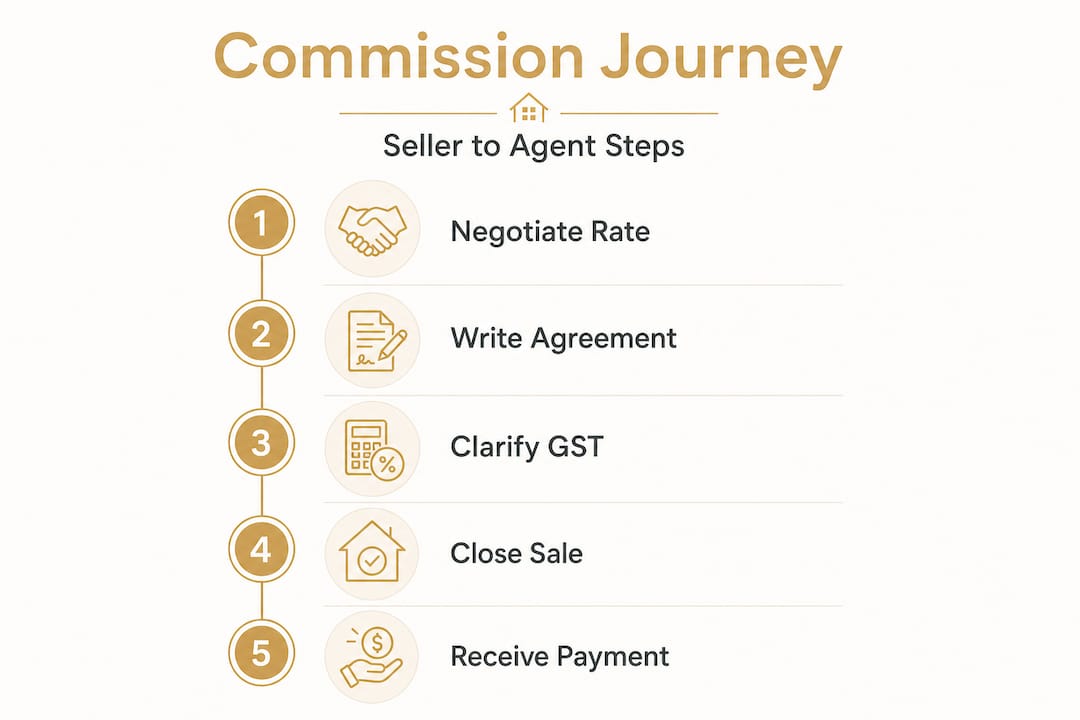
DIY selling reduces commission costs, but it shifts the workload and risk onto you. That’s the core trade-off. Neither path is universally better. The right choice depends on your situation.
When hiring an agent makes sense:
You are unfamiliar with HDB’s resale process or private property conveyancing
You have limited time to manage viewings, negotiations, and paperwork
Your property is complex (multiple owners, outstanding loans, legal encumbrances)
You want professional pricing advice backed by recent transaction data
When DIY or a flat-fee platform makes sense:
You are comfortable with HDB’s online portals and resale procedures
You have time to manage the process and respond to buyers promptly
You want to maximize your net proceeds without paying percentage-based commission
You prefer direct control over who views your home and how negotiations proceed
The middle ground: fixed-fee platforms
There is a third option that many sellers overlook. Fixed-fee platforms let you list your property, manage inquiries, and close the sale without paying a percentage commission. Instead, you pay a flat fee regardless of your sale price. The fixed fee selling benefits are especially clear on higher-value properties, where percentage commissions become very expensive. Understanding the flat fee advantages for sellers can help you decide if this model fits your situation.
Pro Tip: Before choosing any path, calculate your total cost in dollars, not percentages. Include GST, any admin fees, and the value of your own time. Then compare that against the flat-fee alternative. The numbers often make the decision obvious.
Our perspective: the commission myth costs sellers more than they realize
Here is something most sellers don’t think about until it’s too late: the commission you pay is not just a transaction cost. It’s a reflection of how much control you surrendered during the sale.
When you hand over the process to an agent on a percentage basis, you create a subtle misalignment. The agent earns more if the price is higher, yes. But they also earn something by closing fast, even if a slightly longer wait would have produced a better offer. Speed and maximum price don’t always align, and the agent’s incentive isn’t always identical to yours.
This doesn’t mean agents are untrustworthy. Many are excellent professionals. But it does mean that understanding commission structure helps you ask better questions and set clearer expectations.
The sellers who get the best outcomes are the ones who treat commission as a negotiable cost of service, not an unavoidable tax on their sale. They compare options, document everything, and stay engaged throughout the process. Whether you hire an agent, go DIY, or use a flat-fee platform, that mindset puts you in control.
The real cost of not understanding commission isn’t just the dollars you pay. It’s the decisions you make without full information.
Sell smarter with Pallipallisell.com
If you’ve read this far, you already think differently about agent commission than most Singapore homeowners. Now put that knowledge to work.
Pallipallisell.com gives you a direct, transparent way to sell your HDB flat or private property without paying percentage-based commission. For a flat fee of just $688, you get a full listing, direct buyer access, and complete control over your sale from start to finish. No percentage taken from your sale price. No hidden fees. No middleman deciding what information you receive or which offers you see. Whether you’re selling an HDB flat or a private home, list your property today and keep more of what your home is worth.
Frequently asked questions
Is real estate agent commission in Singapore negotiable or fixed?
It is always negotiable. There is no government-fixed rate, so you must agree on a rate directly with your agent before signing any agreement.
Do I have to pay commission if I sell my HDB flat on my own?
No. When selling on your own, you avoid agent commission entirely, but you must handle all resale procedures, paperwork, and negotiations yourself.
Should GST be included in the commission rate?
This must always be clarified in your agent agreement in writing, since GST may be included or excluded depending on the agency’s registration status.
What is co-broking in real estate, and how does it affect commission?
Co-broking means both buyer and seller have separate agents. Under SEAA best-practice guidance effective July 2024, each agent should collect fees from their own client, reducing conflicts of interest.
What are the main risks of selling without an agent?
You save on commission but must manage the full resale process, legal documents, and buyer negotiations on your own. DIY selling shifts all workload and risk onto you, which increases the chance of errors or a lower final sale price.
Recommended


Comments