HDB Selling Fees You Can't Avoid: 2026 Guide
- Pallipallisell

- Jun 17
- 8 min read

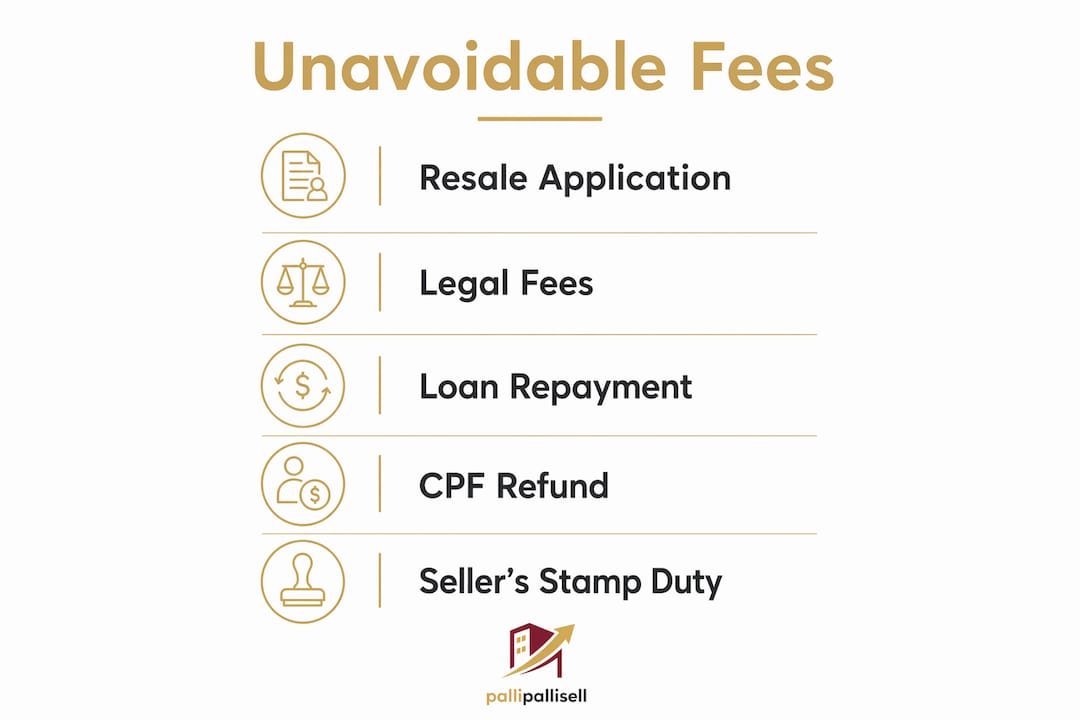
Unavoidable fees when selling an HDB flat are the mandatory costs every seller must pay to legally complete the resale transaction. These are not optional charges you can negotiate away. They include HDB administrative fees, conveyancing costs, outstanding loan repayment, CPF refund obligations, and potentially Seller’s Stamp Duty. Knowing what fees are unavoidable when selling your HDB flat before you list protects your cash flow. Most sellers focus on the sale price and forget that several deductions hit before any cash reaches their hands. Budget for these costs early so the final numbers do not surprise you at completion.
What fees are unavoidable when selling your HDB flat?
The unavoidable fees in the HDB resale process fall into four main categories: statutory administrative fees, legal conveyancing costs, mandatory loan and CPF repayments, and Seller’s Stamp Duty under certain conditions. Each one is process-gated, meaning HDB or the legal system requires payment before the next step can proceed. You cannot skip or defer them without stalling or canceling your sale. Understanding the full picture of HDB selling costs before you sign anything puts you in control.
The HDB resale process is formally structured around document endorsements and payment deadlines. HDB’s selling process shows that unavoidable fees are triggered at specific milestones, not all at once. That means your cash obligations are spread across the timeline, but each one is firm. Missing a payment window creates delays and can add costs on top of what you already owe.

What statutory and administrative fees must sellers pay?
HDB charges a fixed resale application fee of $40 for 1-room and 2-room flats, and $80 for 3-room flats and above. Both buyer and seller pay this fee separately. It is a small but non-negotiable charge that kicks in when you submit your resale application to HDB.
Before you can even issue an Option to Purchase, you must complete the Intent to Sell step. HDB requires a minimum 7-day holding period after declaring Intent to Sell before you can grant the Option to Purchase to a buyer. This is a statutory cooling-off period, not a formality. It locks your timeline and means you cannot rush the process even if you have a willing buyer on day one.
Here is a quick breakdown of the key statutory fees and timing obligations:
Intent to Sell declaration: Free to submit, but triggers the mandatory 7-day wait before OTP issuance
HDB resale application fee: $40 (1-2 room) or $80 (3-room and above), paid by seller at application stage
Document endorsement deadlines: After HDB issues notices, you must pay required fees within the stated window
Missed payment consequences: Delays or missed windows can trigger extension charges or force you to reapply, adding both time and cost
Pro Tip: Set calendar reminders the moment HDB issues any notice or endorsement request. The payment windows are short, and missing them is one of the few ways a seller accidentally creates avoidable extra costs on top of the mandatory ones.
For a full breakdown of what these fixed HDB selling fees cover at each stage, it helps to map them against the resale timeline before you start.
How do legal and conveyancing fees impact sellers?
Conveyancing is the legal process of transferring property ownership from seller to buyer. Every HDB resale requires it. You cannot complete a sale without a conveyancing lawyer or an HDB-appointed conveyancer handling the legal documentation. This makes conveyancing fees a fixed part of your HDB selling expenses, regardless of how straightforward your transaction is.
Typical fees when selling an HDB flat through the conveyancing process include:
Valuation request fee: Approximately $150, required to establish the flat’s market value
Legal fees: Vary by conveyancer but are unavoidable; HDB-appointed conveyancers offer a lower-cost option
Stamp duties: Payable based on transaction value and applicable rules
Bank-related legal fees: If your buyer uses a bank loan, additional legal representation may be required
The legal fees and stamp duties involved in conveyancing can increase if bank financing is part of the transaction. Even if you choose the most affordable HDB-appointed conveyancer, the buyer’s bank financing often requires a separate legal firm, which adds a layer of cost to the overall process. This is one of the most commonly underestimated fees when selling an HDB flat.
Pro Tip: Engage your conveyancer as early as possible, ideally before you issue the Option to Purchase. Late engagement leads to rushed document preparation, which increases the risk of errors and delays that cost you money.
Check the HDB resale commission rates guide to see how conveyancing fits into the broader picture of what sellers pay across the full transaction.
Why must sellers repay outstanding loans and CPF monies?
Your outstanding home loan must be fully cleared before the HDB resale can complete. This is not a choice. The loan repayment is deducted directly from your sale proceeds at completion. If you owe $200,000 on your mortgage and your flat sells for $500,000, you do not receive $500,000 in cash. You receive the balance after the loan is cleared.
The CPF refund obligation works the same way. If you used CPF funds to pay for your flat, including the monthly mortgage installments, you must refund the full amount used plus accrued interest back to your CPF Ordinary Account. The CPF refund with interest is subtracted from your sale proceeds at completion. This surprises many sellers who assume CPF money already spent is gone. It is not. It must be returned.
Here is how your net cash proceeds are actually calculated:
Item | Impact on Proceeds |
Sale price | Starting figure |
Outstanding home loan | Deducted at completion |
CPF refund (principal + accrued interest) | Deducted at completion |
Conveyancing and legal fees | Deducted or paid separately |
HDB administrative fees | Paid at application stage |
Net cash in hand | What remains after all deductions |
Pro Tip: Ask your CPF board for a CPF usage statement early in the process. This tells you exactly how much must be refunded, so you can calculate your real net proceeds before you commit to a sale price.
Many sellers underestimate that unavoidable fees are deducted from proceeds rather than paid externally. Budget based on net proceeds, not the headline sale price.
When is seller’s stamp duty unavoidable in an HDB sale?
Seller’s Stamp Duty, commonly called SSD, is a tax imposed on sellers who sell their HDB flat within a certain holding period. For flats purchased after 4 July 2025, SSD applies with tiered rates based on how long you have held the property. If you sell within 4 years of purchase, SSD is unavoidable.
Here is how the SSD tiers work for HDB flats:
Holding Period | SSD Rate |
Up to 1 year | 16% of sale price |
1 to 2 years | 12% of sale price |
2 to 3 years | 8% of sale price |
3 to 4 years | 4% of sale price |
More than 4 years | 0% (no SSD) |
SSD is calculated on the higher of the sale price or the market value. On a $500,000 flat sold within the first year, SSD alone would be $80,000. That is a significant deduction that wipes out a large portion of your proceeds. The only way to avoid SSD entirely is to hold your flat for more than 4 years before selling.
If you are approaching the 4-year mark, delaying your sale by even a few months could save you tens of thousands of dollars. Timing your resale around the SSD threshold is one of the most financially impactful decisions you can make as a seller.
What other smaller unavoidable fees should sellers expect?
Beyond the major costs, several smaller fees are built into the HDB resale process. They are individually modest but add up. These additional costs include pro-rated property tax, service and maintenance charges, and mortgage discharge fees.
Here is what to expect:
Pro-rated property tax: You pay property tax up to the completion date. The buyer takes over from that point. The split is calculated at completion.
Service and conservancy charges: Outstanding charges on your flat must be cleared before completion. Any arrears come out of your proceeds.
Mortgage discharge fee: If you have a bank loan, your bank charges a fee to formally discharge the mortgage on the property. This varies by bank but is unavoidable if a bank loan is involved.
Flat inspection costs: Some inspection-related costs are embedded in the process and cannot be separated from the overall transaction.
These smaller fees are easy to overlook when you are focused on the big numbers. Build a buffer of at least $1,000–$2,000 into your budget to cover them without stress.
Key takeaways
Selling an HDB flat requires budgeting for net proceeds, not the sale price, because every unavoidable fee is deducted before cash reaches your hands.
Point | Details |
Administrative fees are fixed | HDB charges $40 or $80 per resale application depending on flat size. |
Conveyancing is mandatory | Legal fees apply to every HDB resale and increase if bank financing is involved. |
Loan and CPF refunds reduce cash | Outstanding mortgage and CPF principal plus interest are deducted from sale proceeds at completion. |
SSD can be avoided with timing | Holding your flat for more than 4 years eliminates Seller’s Stamp Duty entirely. |
Smaller fees add up | Property tax, service charges, and mortgage discharge fees create an additional buffer need of $1,000–$2,000. |
What sellers get wrong about their net proceeds
Most sellers I speak with anchor on the sale price and work backward. That is the wrong direction. The number that matters is what lands in your bank account after every deduction clears. I have seen sellers plan their next purchase, their renovation budget, and their moving timeline around a figure that does not exist once the CPF refund and outstanding loan come off the top.
The CPF accrued interest piece catches people off guard every time. You used CPF funds years ago, the money feels spent, and then at completion you find out you owe the CPF board not just what you withdrew but years of compounded interest on top of it. On a flat held for 10 years with significant CPF usage, that interest figure can be substantial.
My advice is simple. Before you set your asking price, get three numbers in writing: your outstanding loan balance, your CPF usage statement, and a conveyancing fee estimate. Add those together, subtract from your target sale price, and that is your real starting point. Everything else is negotiation.
The sellers who avoid surprises are the ones who treat the fee calculation as step one, not an afterthought. Understanding the hidden fees in property transactions in Singapore before you list is the single best thing you can do to protect your financial outcome.
— Brandon
Sell your HDB flat without paying agent commissions
You now know every unavoidable fee in the HDB resale process. The one cost that is very much avoidable is the traditional agent commission, which runs 1%–2% of your sale price. On a $500,000 flat, that is $5,000–$10,000 out of your pocket for a service you can manage yourself.
Pallipallisell offers a flat fee of $688 to list and sell your HDB flat directly to buyers, with no commission and full control over your sale. You handle the negotiation, Pallipallisell handles the platform. Check out the affordable selling fee options and see exactly what you get for $688. You can also browse the property listings to see how other sellers are presenting their flats to buyers right now.
FAQ
What are the unavoidable fees when selling an HDB flat?
The unavoidable fees include HDB’s resale application fee ($40 or $80), conveyancing costs, outstanding home loan repayment, CPF refund with accrued interest, and Seller’s Stamp Duty if you sell within 4 years of purchase.
How much is the HDB resale application fee for sellers?
HDB charges sellers $40 for 1-room and 2-room flats and $80 for 3-room flats and above. Both buyer and seller pay this fee separately at the application stage.
Can sellers avoid seller’s stamp duty on an HDB flat?
Yes. SSD is only triggered if you sell within 4 years of purchase. Holding your flat for more than 4 years results in a 0% SSD rate, making it fully avoidable with careful timing.
Does the CPF refund reduce my cash proceeds from the sale?
Yes. Any CPF funds used to purchase or service the flat, plus accrued interest, must be refunded to your CPF Ordinary Account at completion. This is deducted from your sale proceeds before cash is released to you.
What happens if i miss a payment deadline during the HDB resale process?
Missing a payment window after HDB issues a notice can trigger extension charges or force you to reapply, adding both time and additional costs to your transaction.
Recommended


Comments