Hidden fees in property transactions Singapore: what sellers must know

You’ve done the math. Sold price minus outstanding loan equals your profit. Simple, right? Wrong. Hidden fees in property transactions Singapore sellers face can quietly erase tens of thousands of dollars from that number before you see a cent of cash. CPF accrued interest, Seller’s Stamp Duty, resale levies, administrative fees — none of these show up in the headline sale price, but all of them hit your bank account. This guide breaks down every major hidden charge so you can plan your sale with clear eyes and walk away with the proceeds you actually expect.
Table of Contents
Understanding mandatory seller taxes: Seller’s Stamp Duty (SSD)
CPF accrued interest refund: the hidden financial shock most sellers miss
Planning for cash-only costs: The HDB resale levy and liquidity demands
Practical tips to minimize hidden fees and maximize your sale proceeds
Why most Singapore sellers get caught off guard by hidden fees — and how to be different
Simplify your property sale with Pallipallisell’s expert fixed-fee services
Key Takeaways
Point | Details |
Seller’s Stamp Duty (SSD) | SSD is a tiered tax on properties sold within 3 to 4 years, costly if timing is off. |
CPF accrued interest refund | Mandatory refund of CPF principal plus 2.5% annual accrued interest reduces your sale proceeds. |
HDB resale administrative fees | Fees like valuation and application charges apply and can catch sellers unprepared. |
HDB resale levy cash impact | Resale levy for subsidized flat upgraders must be paid in cash and significantly affects liquidity. |
Planning reduces hidden costs | Voluntary CPF refunds, proper timing, and cash management minimize unexpected expenses. |
Understanding mandatory seller taxes: Seller’s Stamp Duty (SSD)
Before you grant anyone an Option to Purchase (OTP), check your holding period. Seller’s Stamp Duty is one of the most significant property transaction costs Singapore sellers overlook, and getting the timing wrong can cost you a five-figure sum.
SSD applies when you sell residential property within a specific window after acquisition. SSD rates are tiered based on how long you’ve held the property, and they can be steep. Here’s a quick breakdown for properties acquired on or after January 11, 2011:
Holding period | SSD rate |
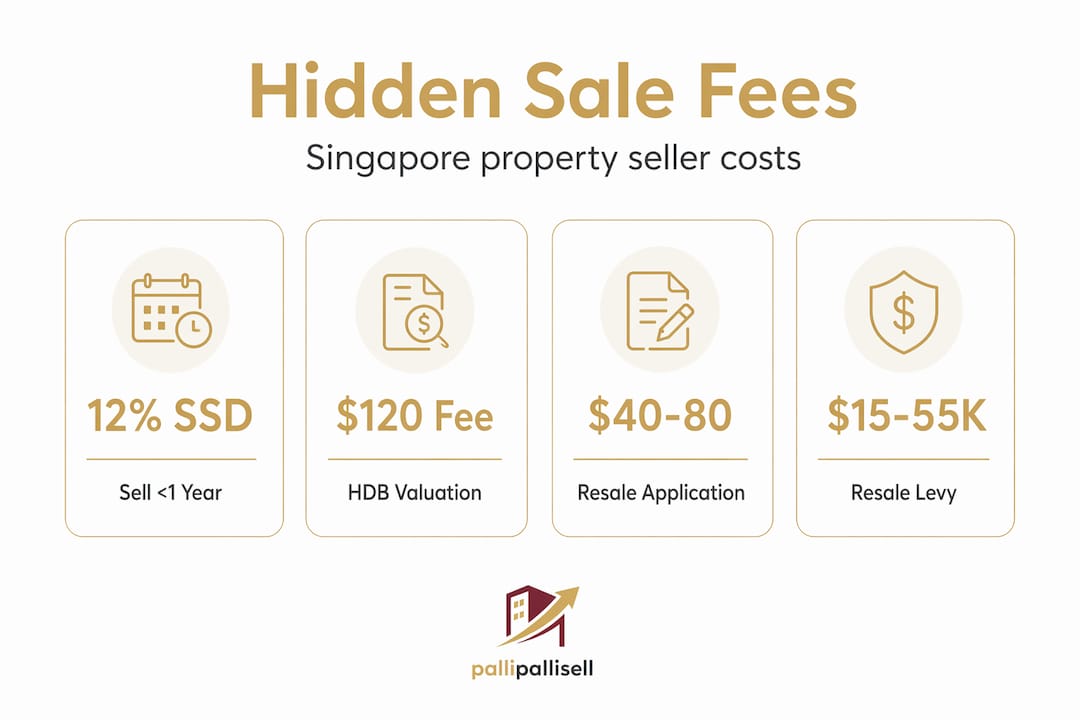
Up to 1 year | 12% |
More than 1 year, up to 2 years | 8% |
More than 2 years, up to 3 years | 4% |
More than 3 years | No SSD |
SSD is calculated on the higher of the sale price or market value. You have 14 days from the date of contract signing to pay it. Miss that window and you face additional penalties.
Key facts to know:
HDB flats are generally exempt because the Minimum Occupation Period (MOP) of 5 years ensures you’ve held the flat well past the SSD window.
Private property sellers need to count their holding period carefully from the date of purchase completion, not the OTP date.
If you’re close to the 3-year mark, even a few days can make the difference between paying 4% and paying nothing.
Pro Tip: If your holding period ends in 6 to 8 weeks, coordinate with your lawyer to time OTP signing after the 3-year mark passes. A one-month delay on signing could save you 4% of the sale price. On a $900,000 property, that’s $36,000 in savings. Review the agent commission guide to see how this stacks against the commissions you’re already saving by selling independently.
Now that you know the key taxes, let’s explore the critical refund obligations related to CPF usage.
CPF accrued interest refund: the hidden financial shock most sellers miss
This is the one that blindsides sellers most. You used CPF funds to pay your downpayment, monthly mortgage installments, stamp duties, and legal fees. You assumed those funds were “spent.” They weren’t — not in the eyes of CPF.
When you sell, you must refund all CPF OA funds used plus 2.5% per annum accrued interest compounded annually. Every dollar of CPF that went into your property is tracked. Interest has been accumulating every year since you first drew it.
Here’s how the math plays out in practice:
Identify your total CPF withdrawn. This includes downpayment, all monthly repayments made in CPF, plus any stamp duties or legal fees paid from CPF.
Calculate the accrued interest. At 2.5% compounded annually, a $200,000 CPF withdrawal over 10 years grows to approximately $256,000 in refund obligation.
Deduct that total from your sale proceeds. The refund goes back to your CPF Ordinary Account (OA), not to you as cash.
Calculate your actual cash-in-hand. After settling the mortgage, refunding CPF plus interest, and paying all other fees, what’s left is your real cash proceed.
“The CPF refund isn’t a cost in the traditional sense — it’s your own retirement savings being restored. But because it goes back to CPF and not your pocket, many sellers experience it as a cash shortfall.”
The refund is not negotiable. There is no appeal process. Understanding the financial pitfalls of selling before you commit to a sale price is critical. Sellers who price their home based on the mortgage balance alone — ignoring CPF accrued interest — often find their net cash is far less than anticipated.
Pro Tip: If you have spare cash, make a voluntary CPF housing refund before you sell. Every dollar you refund early stops accruing interest from that date forward. This is one of the most powerful and under-used tools available to Singapore property sellers.
After understanding CPF refunds, let’s examine other administrative costs in HDB resale transactions.
Administrative costs and fees in HDB resale transactions
HDB resale transactions come with their own set of administrative fees. They’re not enormous individually, but when they hit simultaneously during a stressful sale, they add up fast.
Key fees to expect:
HDB valuation fee: $120. This is mandatory. You must request it after granting the OTP but before the buyer exercises it. Poor timing here causes real problems.
Resale application fee: $40 to $80 depending on flat size, payable when you submit the resale application to HDB.
Early loan redemption penalty: If you’re on a bank loan with a lock-in period and you sell before it ends, expect a penalty of approximately 1.5% of the outstanding loan. On a $300,000 outstanding loan, that’s $4,500.
Legal fees: Conveyancing for HDB resale typically runs $1,500 to $3,000 depending on complexity.
The valuation step deserves special attention. Request HDB valuation at the right time to avoid Cash Over Valuation (COV) surprises. If your buyer’s offer exceeds the HDB-assessed value, the difference must be paid entirely in cash by the buyer. A delayed or poorly timed valuation request can jeopardize the buyer’s financing and derail your sale.
Fee type | Approximate cost |
HDB valuation fee | $120 |
Resale application fee | $40 to $80 |
Legal/conveyancing fees | $1,500 to $3,000 |
Early redemption penalty | ~1.5% of outstanding loan |
Pro Tip: Check your bank loan agreement for lock-in clauses before you set your sale timeline. If you’re 4 months from the end of your lock-in period, waiting can save you thousands. Visit the HDB resale fees breakdown for a complete picture of what you’re looking at.
With fees and taxes explained, let’s clarify critical cash obligations related to the HDB resale levy for upgraders.
Planning for cash-only costs: The HDB resale levy and liquidity demands
If you’re selling your HDB flat to upgrade to a Build-to-Order (BTO) flat, an Executive Condominium (EC), or another subsidized flat, the HDB resale levy is a mandatory cash payment. This one surprises sellers who plan their cash flow purely around the mortgage balance.
Key points about the HDB resale levy:
Range: $15,000 to $55,000 depending on your original flat type.
Payment method: Cash only. CPF cannot be used.
Timing: Payable when you complete the purchase of your next subsidized flat.
Who it applies to: Second-time buyers of subsidized housing. If you buy a private property next, no levy applies.
The cash-only requirement creates a real liquidity squeeze. You’re simultaneously managing the sale of your current flat, refunding CPF accrued interest, paying legal fees, and now setting aside up to $55,000 in cash for the levy before you complete your next purchase.
Pro Tip: Map out your cash demands on a single timeline before you list your property. Include the CPF refund amount (which locks back into CPF, not available as cash), the resale levy, legal fees, and stamp duties on your next purchase. You’ll quickly see whether your sale proceeds are enough, or whether you need bridging financing. Understand the full HDB resale levy impact so you can plan without surprises.
Understanding these cash-only costs leads us into practical strategies to manage all hidden fees effectively.
Practical tips to minimize hidden fees and maximize your sale proceeds
Knowing the fees is the first step. Acting on that knowledge is what actually protects your proceeds. Here’s how to reduce what you pay.
Pay monthly mortgage installments in cash, not CPF. Every CPF dollar you save from going into the mortgage reduces your future CPF refund obligation and the interest that accumulates on it.
Make voluntary CPF housing refunds early. As soon as you have spare cash, refund it to your CPF housing account. This stops interest from compounding on that amount from the date of refund. Voluntary CPF refunds are one of the most effective ways to reduce the total cost of selling.
Time your OTP signing to clear the SSD window. Coordinate contract signing to occur just after your SSD holding period ends. Even a few days can eliminate a 4% tax bill.
Request the HDB valuation immediately after granting OTP. Don’t delay. A slow valuation creates COV risk and can slow down buyer financing approval.
Review your bank loan lock-in period. If you’re close to the end, hold off. If you’re deep in the lock-in, factor the early redemption penalty into your pricing.
Budget for all lump-sum cash costs on a single sheet. This includes the levy (if applicable), legal fees, SSD (if any), and loan redemption costs.
Additional strategies worth considering:
If liquidity is tight, explore whether a lease buyback scheme fits your situation.
Get a CPF statement showing total withdrawals and accrued interest before pricing your property. Many sellers don’t do this until it’s too late.
Pro Tip: Use the FSBO tips at Pallipallisell to understand the full independent selling process, and bookmark the seller’s resource blog for ongoing guidance on fees, timelines, and documentation.
Having covered key hidden fees and savings strategies, let’s share unique insights on navigating this complex landscape.
Why most Singapore sellers get caught off guard by hidden fees — and how to be different
Here’s the uncomfortable truth: most sellers don’t budget for hidden charges buying property or selling property because they treat the sale as a simple math equation. Sale price minus mortgage balance equals profit. That formula is wrong, and it’s wrong in an expensive way.
The CPF accrued interest issue is particularly telling. Most sellers underestimate the compound effect of CPF interest and treat the refund as a formality rather than a significant financial event. A seller who used $250,000 of CPF over 12 years will owe roughly $130,000 in accrued interest on top of the principal. That money goes back to CPF, not to their bank account.
The sellers who stay ahead of these costs share a few habits. They pull their CPF statement months before selling. They check their loan agreement for lock-in clauses before setting a timeline. They run the full cash flow calculation, not just the headline surplus.
Timing is also psychological. A seller who rushes a sale to “get it over with” and then finds out they owe SSD on top of CPF refunds faces not just financial stress but a real sense of regret. Planning your sale timeline properly removes that regret entirely.
Voluntary CPF refunds are perhaps the most under-used tool in Singapore residential property sales. Sellers with spare cash often park it in a savings account or fixed deposit. Putting it back into CPF housing instead reduces the compounding interest base and saves real money at the point of sale.
Selling independently through a platform like Pallipallisell means you’re already saving $20,000 to $40,000 in agent commissions. Don’t let poor fee planning give that savings back to administrative costs and taxes. See the commission saving insights for a clear picture of what a well-planned, independent sale can achieve.
Simplify your property sale with Pallipallisell’s expert fixed-fee services
You now know the fees. You know what to watch for, when to act, and how to plan. The next question is: who helps you execute without burning money on commissions?
Pallipallisell is built for exactly this situation. Sellers like you who want full control, full transparency, and zero agent commissions. The platform charges a low fixed HDB selling fee of just $688 — no percentage, no surprises, no commission cutting into your proceeds. You get direct access to buyers, full listing visibility, and support through every stage of the sale. Browse the property listing services to see how the platform works, and when you’re ready to take the next step, sell your property on your own terms, starting today.
Frequently asked questions
What is Seller’s Stamp Duty (SSD) and when do I have to pay it?
SSD is a government tax applied when you sell residential property within 3 years of purchase, with tiered rates starting at 12%. You must pay within 14 days of signing the sales contract.
How does CPF accrued interest affect my property sale proceeds?
When selling, you must refund all CPF OA funds used plus 2.5% per annum accrued interest compounded yearly, which reduces the actual cash you receive from the sale.
Are there any fees specific to HDB resale flats I should know about?
Yes, including a $120 valuation fee after the OTP, resale application fees of $40 to $80, and potential early loan redemption penalties of approximately 1.5% if you sell during a bank lock-in period.
What is the HDB resale levy and how does it affect me as a seller?
The HDB resale levy ranges from $15,000 to $55,000 and must be paid entirely in cash when you upgrade to another subsidized flat, requiring careful advance cash flow planning.
How can I reduce or manage hidden fees when selling my property by myself?
Time your sale to clear the SSD holding period, make voluntary CPF refunds to stop accrued interest compounding, pay mortgage installments in cash where possible, and use careful OTP timing to eliminate unnecessary tax costs.
Recommended


Comments