Singapore Property Commission Structure Explained for Sellers

Property commission structure in Singapore is a set of customary fee arrangements between property owners, buyers, and agents, regulated for transparency by the Council for Estate Agencies but negotiated on a case-by-case basis rather than fixed by law. Most homeowners discover this only after signing an agency agreement, which is far too late to negotiate effectively. This article breaks down the property commission structure Singapore sellers need to understand across HDB resale, private resale, new launches, and rentals, including who pays what, how GST applies, and where you have real room to negotiate.
What is the property commission structure in Singapore?
Property agent commission in Singapore is not a government-mandated rate. The CEA regulates disclosure and ethical conduct, not the actual percentage charged. This distinction matters because it means every commission you see quoted is a market convention, not a legal requirement. You can negotiate it.
The formal term for the written agreement governing this arrangement is the Estate Agency Agreement (EAA). It specifies the commission percentage, GST treatment, exclusivity terms, and payment timing. Commission is paid only upon successful transaction completion, not when you sign the listing agreement. That single fact protects you from paying for a sale that never closes.
Market norms differ significantly across property types. HDB resale, private resale, new condominium launches, and rental transactions each follow different conventions for who pays, how much, and how the fee is split between agents. Understanding each category separately is the fastest way to avoid overpaying.
How do HDB resale commissions work and who pays them?
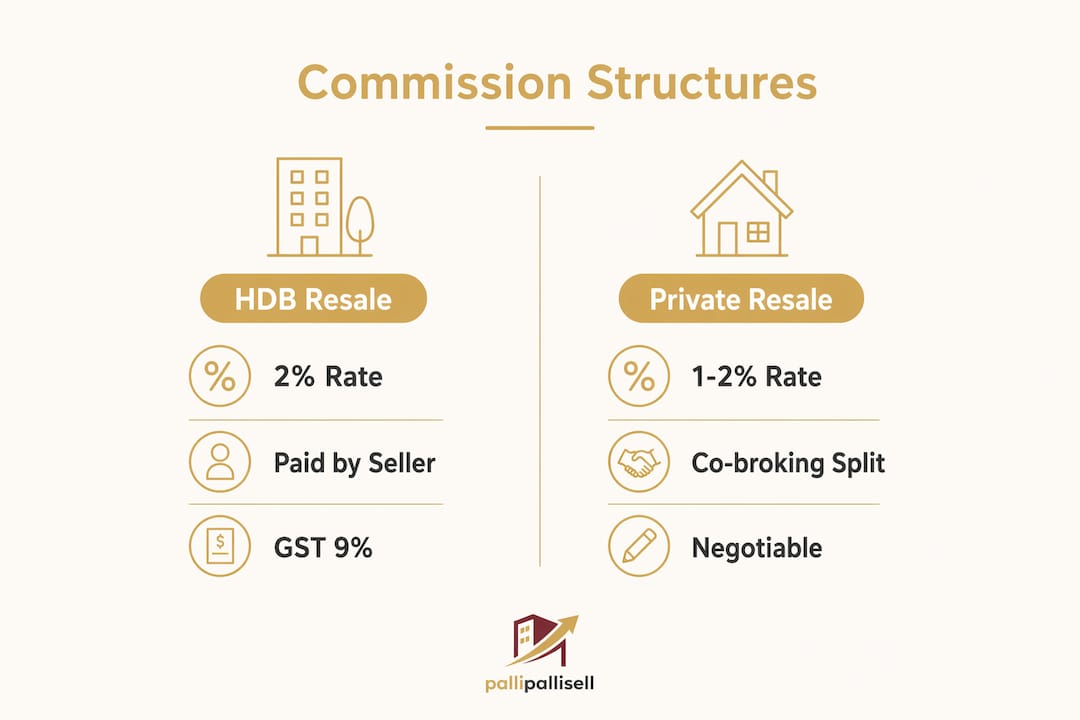
HDB resale is the most common transaction type for Singapore homeowners, and the commission structure here is relatively standardized. The seller typically pays about 2% plus 9% GST to their agent, while the buyer’s agent receives about 1% plus GST, usually paid by the buyer.
Here is a concrete breakdown for a S$700,000 HDB resale flat:
Seller’s agent commission: 2% of S$700,000 = S$14,000
GST on seller’s commission (9%): S$1,260
Total seller pays: S$15,260
Buyer’s agent commission: 1% of S$700,000 = S$7,000
GST on buyer’s commission (9%): S$630
Total buyer pays: S$7,630
That S$15,260 is real money leaving your pocket at closing. Many sellers treat it as a fixed cost, but it is not. The HDB Resale Portal allows buyers to transact directly without an agent, which means you may not always be paying a co-broke commission to a buyer’s agent. If your buyer comes unrepresented, that 1% disappears from the equation entirely.
Always verify your agent’s CEA registration before signing anything. The CEA public register is free to search and confirms both registration status and whether the agent’s agency is GST-registered. An unregistered agent cannot legally collect commission in Singapore.
Pro Tip: Ask your agent upfront whether their commission quote is inclusive or exclusive of GST. Many quotes are exclusive, meaning the real cost is 9% higher than the headline number.
How does commission work in private resale and co-broking?
Private residential resale follows a slightly different structure. The seller’s commission ranges from 1% to 2%, with 2% being the common market norm. The buyer rarely pays a separate commission because the seller’s agent shares the fee with the buyer’s agent through a co-broke arrangement.

Here is how a typical co-broke split looks on a S$1.5 million private apartment:
Party | Commission rate | Amount (before GST) |
Seller’s agent | 1% | S$15,000 |
Buyer’s agent (co-broke) | 1% | S$15,000 |
Total seller pays | 2% | S$30,000 |
Buyer pays | 0% | S$0 |
The co-broke model means the seller funds both sides of the transaction. This is standard practice, but it creates an incentive structure worth understanding. Your agent has a financial reason to bring in a co-broke buyer’s agent quickly, which may or may not align with getting you the best price. For higher-value properties, negotiating the total commission down to 1.5% or even 1% is realistic, especially if you grant exclusivity or the property is priced to sell fast.
Dual representation, where one agent acts for both buyer and seller, requires written disclosure and consent from both parties under CEA’s Code of Ethics. If your agent proposes this arrangement, read the terms carefully. The conflict of interest is real, and you should understand exactly what fee the agent collects from each side.
Pro Tip: For private properties above S$2 million, always negotiate commission before signing the EAA. Agents expect it at this price point, and a 0.25% reduction saves you S$5,000 or more.
What is the commission structure for new condo launches?
New condominium launches operate on a completely different model. Buyers pay no direct agent commission in new launch purchases. The developer pays the marketing fee directly to appointed agencies.
Key facts about new launch commissions:
Developers typically pay marketing fees of 2% to 5% to agencies, depending on project location, phase, and sales targets.
The agency then pays individual agents from that pool, often with tiered incentives for hitting sales quotas.
Commission rates vary by launch phase. Early phases often carry higher developer commissions to drive momentum.
Agents may offer buyers a rebate from their commission, subject to CEA disclosure rules. Any rebate must be declared in writing.
This structure matters if you are a homeowner selling a private property and competing with new launches nearby. Buyers shopping in your area may be steered toward new launches by agents earning higher developer commissions. Knowing this helps you price and market your resale unit more effectively.
How do rental commissions work in Singapore?
Rental commission norms differ between HDB and private residential properties, and the split between landlord and tenant is not always equal.
For HDB whole-unit rentals, the standard commission is about one month’s rent split equally between landlord and tenant for a one-year lease. That means each party pays half a month’s rent to their respective agent.
Property type | Lease duration | Landlord pays | Tenant pays |
HDB whole unit | 1 year | 0.5 month rent | 0.5 month rent |
Private residential | 1 year | 1 month rent | Varies by agreement |
Private residential | 2 years | 1 month rent | Negotiable |
For private residential rentals, the landlord typically pays one month’s rent as commission, regardless of lease length. The tenant’s agent fee varies and is often negotiated separately. On higher-value rentals above S$5,000 per month, tenants sometimes pay nothing if the landlord’s commission is sufficient to cover both agents through a co-broke split.
Commission for rentals is payable only on successful lease signing, not on viewings or negotiations. Get this confirmed in writing before your agent starts marketing the unit.
Pro Tip: For private rentals, clarify in the EAA whether the landlord’s commission covers the tenant’s agent through co-broke. If it does, you avoid the tenant facing unexpected fees that could slow down the signing.
What should homeowners know about negotiating commissions?
Commission negotiation is not confrontational. It is a normal part of the transaction, and agents expect it. Here is what gives you leverage:
High property value: Agents earn more in absolute dollars on a S$1.5 million sale at 1.5% than on a S$700,000 sale at 2%. Use this math in your favor.
Exclusivity: Offering a sole agency agreement gives your agent certainty. Use that certainty as a bargaining chip to reduce the percentage.
Low marketing effort required: If your property is in a sought-after location with strong demand, the agent’s work is lighter. That justifies a lower rate.
Written agreement specifics: Always request a written EAA that specifies the commission percentage, GST treatment, exclusivity period, and what happens if the agreement is terminated early.
GST is a common source of confusion. Agencies with annual turnover above S$1 million must register for GST and charge 9% on top of their commission. Smaller brokerages may not be GST-registered, which means their effective cost to you is lower. Always ask whether the quoted commission is inclusive or exclusive of GST, and confirm the agency’s GST registration number before signing.
Dual representation deserves a separate mention. If one agent represents both you and the buyer, written consent is mandatory under CEA rules. This arrangement can speed up a transaction, but it limits your agent’s ability to negotiate purely in your interest. Approach it with clear eyes. For tips on reducing your total outlay, the home seller’s commission guide at Pallipallisell covers negotiation strategies specific to Singapore sellers.
Pro Tip: Always check your agent’s CEA registration at cea.gov.sg before signing any agreement. An unregistered agent cannot legally collect commission, and you have no legal recourse if a dispute arises.
Key takeaways
Singapore property commission is a negotiated fee governed by CEA disclosure rules, not fixed by law, meaning every rate you see is a starting point for discussion.
Point | Details |
Commission is negotiable | No law fixes rates; market norms are starting points, not ceilings. |
GST adds 9% to the total | Always confirm whether quotes are inclusive or exclusive of GST before signing. |
Co-broke splits the seller’s fee | In private resale, the seller typically funds both agents through a 2% total commission. |
New launch buyers pay nothing | Developer marketing fees cover agent commissions entirely in new condominium launches. |
Written EAA is non-negotiable | Always get commission, GST, exclusivity, and termination terms documented before listing. |
Why most homeowners leave money on the table
Most homeowners I speak with assume commission rates are fixed, the way stamp duty is fixed. That assumption costs them thousands of dollars. The CEA framework is built around disclosure, not price control. Every rate you see is a market convention, and conventions exist to be questioned.
The most common mistake I see is signing an EAA without reading the GST clause. A seller who agrees to “2% commission” without clarifying GST status ends up paying 2.18% on a GST-registered agency’s invoice. On a S$1 million property, that is an extra S$1,800 that nobody mentioned at the listing appointment.
The second mistake is assuming you need an agent at all. Platforms like Pallipallisell exist precisely because the HDB Resale Portal and private market tools have made direct selling genuinely accessible. Knowing the commission structure is not just useful for negotiating with agents. It is the foundation for deciding whether you need one in the first place. If you understand what a 2% commission actually funds, you can make a clear-eyed decision about whether that service is worth S$14,000 to you on a S$700,000 flat.
My honest advice: read every clause of your EAA before signing, verify CEA registration, and run the GST math yourself. The savings are real, and the knowledge takes less than an hour to acquire.
— Brandon
Sell your property for a fraction of the usual cost
If you have read this far, you already know more about Singapore property commission than most sellers do when they sign their first agency agreement. That knowledge has real dollar value.
Pallipallisell offers homeowners a direct alternative to traditional agent commissions. Instead of paying 2% plus GST on your HDB sale, you pay a flat fee of S$688. The platform handles listing, buyer communication, and transaction support, giving you full control without the five-figure commission bill. Explore affordable HDB selling fees or learn how to sell your HDB without an agent with Pallipallisell’s step-by-step support. The process is straightforward, transparent, and built for sellers who want to keep more of what their property is worth.
FAQ
What is the typical commission rate for selling an HDB flat?
The seller’s agent commission for an HDB resale flat is typically 2% of the sale price plus 9% GST if the agency is GST-registered. The buyer’s agent receives about 1% plus GST, usually paid by the buyer.
Can I negotiate property agent commission in Singapore?
Yes. Commission rates are not fixed by law and are fully negotiable between you and your agent. High-value properties, exclusive agreements, and strong market demand all give you leverage to negotiate a lower rate.
Who pays the agent commission in a private resale transaction?
The seller pays the total commission, typically 2%, which is then split between the seller’s agent and the buyer’s agent through a co-broke arrangement. The buyer rarely pays a separate fee in private resale transactions.
Does GST apply to property agent commissions in Singapore?
GST at 9% applies to agent commissions where the agency is GST-registered. Always confirm whether a commission quote is inclusive or exclusive of GST, as the difference can amount to thousands of dollars on higher-priced properties.
Do buyers pay commission when purchasing a new launch condo?
No. Buyers pay no direct agent commission on new condominium launches. The developer pays marketing fees of 2% to 5% directly to appointed agencies, making the purchase commission-free for buyers.
Recommended


Comments