What Is an Online Property Marketplace? 2026 Guide
- Pallipallisell

- Jun 16
- 8 min read

An online property marketplace is defined as a digital platform that connects property buyers and sellers without the platform itself owning any of the listings. Think of it as Amazon or eBay built for real estate. Sellers post their properties, buyers search and submit offers, and the platform earns revenue through commissions, listing fees, or subscriptions. Platforms like Zillow operate this way, and so do newer iBuyer models that make all-cash online offers to speed up the sale process. Understanding what is online property marketplace means recognizing that the platform is a facilitator, not an owner. That distinction shapes everything from how you list your home to how quickly you close.
How does an online property marketplace differ from a real estate portal?
Most people use the terms interchangeably. They are not the same thing, and the difference matters when you are deciding where to list or search.
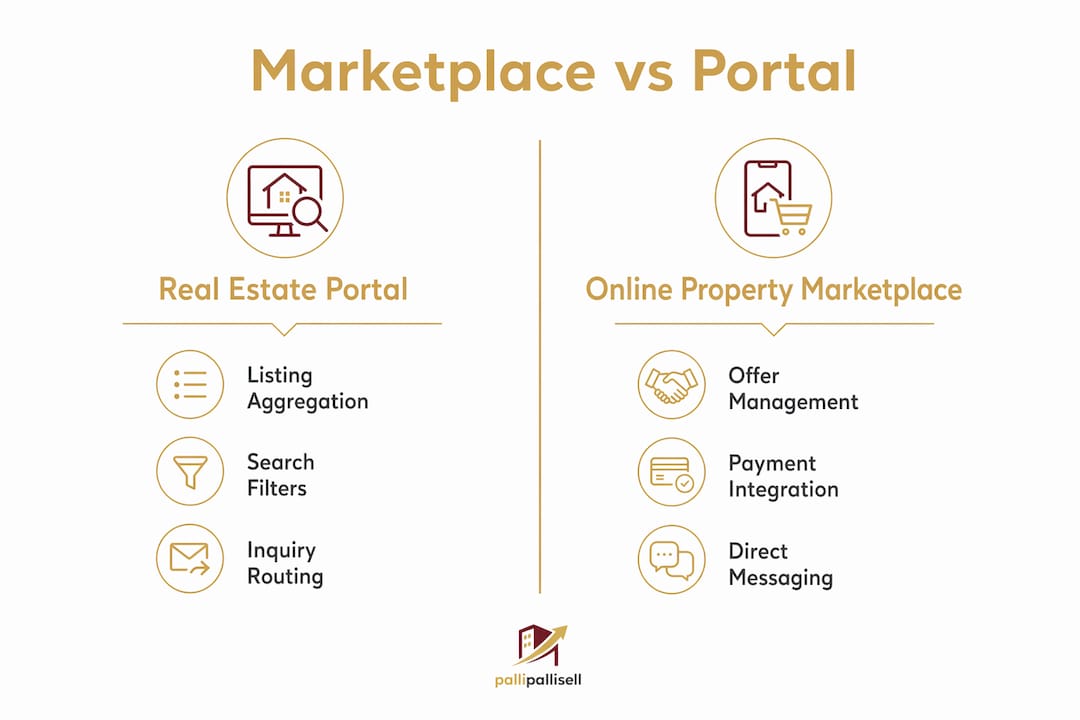
A real estate portal is primarily a listing aggregation tool. It pulls property data from multiple sources, gives you search filters, photos, and maps, and then routes your inquiry to an agent or seller. The portal does not handle your offer, process your payment, or manage your legal documents. It connects you to someone who will.
An online real estate platform built as a true marketplace goes further. It manages the offer process, integrates payment workflows, and sometimes handles legal document routing and closing coordination. The experience is more end-to-end. You are not just browsing. You are transacting.

Here is a direct comparison:
Feature | Real Estate Portal | Online Property Marketplace |
Property search and filters | Yes | Yes |
Lead routing to agents | Yes | Sometimes |
Offer submission tools | No | Yes |
Payment integration | No | Yes |
Legal document workflows | No | Sometimes |
Direct seller-to-buyer contact | Rarely | Yes |
The practical takeaway is this: portals focus on discovery, while marketplaces focus on transaction. Many platforms today blend both functions, which is why the line feels blurry. Zillow, for example, started as a portal and has added marketplace features like Zillow Offers. Knowing which mode a platform operates in tells you how much of the sales process you will manage yourself.
Pro Tip: Before you list or search on any platform, check whether it offers direct messaging, offer submission, and fee transparency. If it only routes you to an agent, it is a portal, not a marketplace.
What are the benefits and challenges of using an online property marketplace?
The benefits are real and significant. The challenges are manageable if you know what to watch for.
Key benefits
24/7 access. You can browse, list, or submit an offer at any hour without scheduling an appointment.
Speed. iBuyer models skip open houses and repairs entirely. Faster sale timelines are one of the most cited reasons sellers choose online marketplaces.
Cost savings. Traditional agent commissions typically run 1%–2% of the sale price. On a $1 million property, that is $10,000–$20,000 in fees. Flat-fee and direct-sale models cut that significantly.
Seller control. You set your price, manage your listing, and decide who you negotiate with.
Buyer reach. Online property listings reach a national or global audience, not just local buyers who walk into an agency.
Challenges to prepare for
Data integrity. Listing quality and verification vary widely across platforms. Inaccurate square footage, outdated photos, or wrong pricing can derail a sale.
Pricing accuracy. Automated valuation tools give estimates, not appraisals. You still need to research comparable sales.
Negotiation readiness. Without an agent in the room, you handle counteroffers yourself. That requires preparation.
Safety and verification. Not all platforms verify buyer identity or financial qualification before allowing contact.
Paperwork. Platforms that do not include legal document support leave you responsible for contracts and compliance.
Pro Tip: Always verify that a platform syndicates your listing to the MLS or major search portals. MLS syndication is one of the strongest drivers of listing visibility and buyer reach.
Hybrid models are worth considering if you want the cost savings of a marketplace with some professional support. These platforms combine digital listing tools with optional agent services for an additional fee. They give you flexibility without forcing you into a full-commission arrangement.
What models and tools do online property marketplaces use?
Understanding how these platforms are built helps you choose the right one and use it more effectively.
At their core, online marketplaces are two-sided platforms. They match independent sellers with buyers without holding inventory. The platform earns money by facilitating that match, not by buying or selling property itself. That is what separates a marketplace from a developer or an agency.
Common revenue models
Commission per transaction. The platform takes a percentage of the sale price when a deal closes.
Listing fees. Sellers pay a flat fee to post their property, regardless of outcome.
Subscription access. Buyers or agents pay monthly fees for premium search tools or lead access.
Hybrid fees. A small upfront listing fee plus a reduced commission on closing.
Technology that powers the experience
Modern online real estate platforms use a stack of tools that go well beyond a photo gallery. Virtual tours let buyers walk through a property remotely. Automated valuation models estimate market price using comparable sales data. Messaging tools connect buyers and sellers directly. All-cash offer engines, used by iBuyers, generate instant purchase offers based on algorithmic pricing.
Flat-fee MLS services are another tool worth knowing. They let sellers list on the MLS for a fixed cost without signing a full-service agent agreement. The seller handles showings, negotiation, and paperwork. The savings can be substantial, but the workload increases.
Platform Model | Who Manages the Sale | Typical Cost Structure |
Full-service marketplace | Platform or agent | Commission-based |
Flat-fee listing | Seller | Fixed upfront fee |
iBuyer | Platform buys directly | Service fee, no commission |
Hybrid portal-marketplace | Seller with optional agent | Variable |
The best property marketplace sites combine strong search tools with transparent fee structures and verified listings. Evaluating a platform on those three criteria alone will save you time and frustration.
How can buyers and sellers use property marketplaces effectively?
Knowing how to use a property marketplace correctly separates a smooth transaction from a stressful one.
For sellers
Write an accurate listing. Include the correct floor area, number of rooms, lease type, and any renovation details. Verified, structured listings build buyer trust and reduce wasted inquiries.
Use professional photos. Clear, well-lit images taken at eye level convert more views into inquiries. Avoid dark corners, cluttered counters, and wide-angle distortion.
Price based on data. Check recent comparable sales in your area, not just asking prices. Overpricing on an online platform is more visible and more damaging than in a traditional setting.
Respond quickly. Buyers on digital platforms expect fast replies. A 24-hour delay can cost you a serious offer.
Understand your platform’s fee structure. Know exactly what you pay and when before you list. Some platforms charge on listing; others charge on closing.
You can learn the full process of listing property independently to avoid surprises before you go live.
For buyers
Use filters precisely. Set your price range, property type, floor area, and location before browsing. Broad searches waste time and create decision fatigue.
Verify listing details. Cross-reference the address, floor area, and price against public records or government databases where available.
Submit offers in writing. Even on informal platforms, document your offer terms, conditions, and timeline in writing.
Ask about platform support. Does the platform offer buyer protection, escrow services, or dispute resolution? Know this before you commit.
Pro Tip: If a platform does not clearly display its fee structure, verification process, and contact options, treat that as a red flag. Transparency is the baseline standard for any credible online real estate platform.
Property buying platforms that include built-in offer management and direct messaging reduce friction significantly. When you can message a seller, submit an offer, and track its status in one place, the process moves faster and with fewer misunderstandings.
Knowing when to bring in a professional is also part of using these platforms well. If your property is unusual, the market is volatile, or the legal requirements in your area are complex, a hybrid model with optional agent support may serve you better than a fully self-managed listing.
Key takeaways
An online property marketplace connects buyers and sellers digitally, cuts traditional commission costs, and gives sellers direct control over their listing, pricing, and negotiation.
Point | Details |
Marketplace vs. portal | Marketplaces handle offers and payments; portals only aggregate listings and route leads. |
Cost savings are real | Flat-fee and direct-sale models eliminate the 1%–2% agent commission on the full sale price. |
Data quality drives results | Accurate, verified listings with strong photos generate more serious buyer inquiries. |
Buyer reach requires syndication | MLS syndication expands your listing’s visibility far beyond a single platform’s audience. |
Know your platform’s scope | Confirm whether your platform handles offers, payments, and documents before you commit. |
Why the shift to online marketplaces is more than a trend
I have spent years watching the real estate industry resist digital change and then scramble to catch up. What strikes me most about online property marketplaces is not the technology. It is the power shift.
For decades, property transactions were controlled by agents who held the information. Buyers could not easily access comparable sales data. Sellers did not know what buyers were seeing or offering. The marketplace model changes that. When 94% of buyers use online resources during their home search, the information advantage that agents once held has largely moved to the platform.
That said, I think most people underestimate how much data quality still matters. A marketplace is only as good as its listings. Platforms that allow unverified, inaccurate, or outdated listings create frustration on both sides of the transaction. The technology is not the hard part. Getting sellers to submit accurate information and getting platforms to enforce quality standards is where most marketplaces still fall short.
The future I see is not fully automated. It is a hybrid where sellers control the process, platforms provide the tools and verification, and professionals step in only when genuinely needed. That model already exists in Singapore through platforms like Pallipallisell, and it is proving that you do not need a full-commission agent to sell your home well. You need the right platform and the right information.
— Brandon
Sell your property directly with Pallipallisell
If you are a Singapore homeowner ready to sell your HDB flat or private property, Pallipallisell gives you everything you need to do it yourself, without paying a traditional agent commission.
Pallipallisell charges a flat fee of $688 to list and market your property directly to buyers. You keep full control over your price, your negotiations, and your timeline. There are no hidden fees and no percentage taken from your sale. You can browse the current property listings to see how sellers present their homes, or go straight to the pricing page to understand exactly what you pay. If you want to compare this approach against traditional agency costs, the digital vs. traditional selling guide lays it out clearly.
FAQ
What is an online property marketplace?
An online property marketplace is a digital platform that connects property buyers and sellers, facilitating search, offers, and transactions without the platform owning the listings. It earns revenue through commissions, listing fees, or subscriptions.
How is a property marketplace different from a real estate portal?
A real estate portal aggregates listings and routes inquiries to agents but does not handle offers or payments. A marketplace goes further by managing the offer process, payment integration, and sometimes legal document workflows.
What are the main benefits of using an online property marketplace?
The main benefits include 24/7 access to listings, faster sale timelines, reduced agent commission costs, and direct seller-to-buyer communication. Flat-fee models can save sellers tens of thousands of dollars compared to traditional commission structures.
Is it safe to buy or sell property on an online marketplace?
Safety depends on the platform’s verification standards. Choose platforms that verify listings, confirm buyer identity, and offer transparent fee structures. Always document offers and agreements in writing regardless of platform.
Can sellers in singapore use online property marketplaces without an agent?
Yes. Platforms like Pallipallisell allow Singapore homeowners to sell without agent fees by listing directly to buyers for a fixed fee of $688, giving sellers full control over pricing, negotiation, and closing.
Recommended

Comments