What Is Property Title in Singapore: 2026 Guide


A property title in Singapore is the definitive legal document that establishes ownership and records all registered interests, encumbrances, and transactions tied to a specific parcel of land or strata unit. The Singapore Land Authority (SLA) maintains the official register of all property titles in the country. Understanding your property title is not optional. Whether you are buying, selling, or simply holding a property, your title is the foundation of every legal right you have over that asset. This guide explains the types of property titles, the legal system behind them, and exactly how ownership transfers from one person to another.
What is property title in Singapore?
A property title deed is the legal record showing ownership, property description, ownership tenure, registered owners, and encumbrances. Think of it as the government’s official statement that you own a specific piece of real estate. It is not just a receipt. It is the legal instrument that defines what you own, how you own it, and what obligations or restrictions are attached to it.
The SLA issues and maintains these records under Singapore’s land registration system. Every time a property changes hands, gets mortgaged, or has a new restriction placed on it, that change is recorded in the SLA register. This makes the title the single most reliable source of truth for Singapore property ownership.

What are the different types of property titles in Singapore?
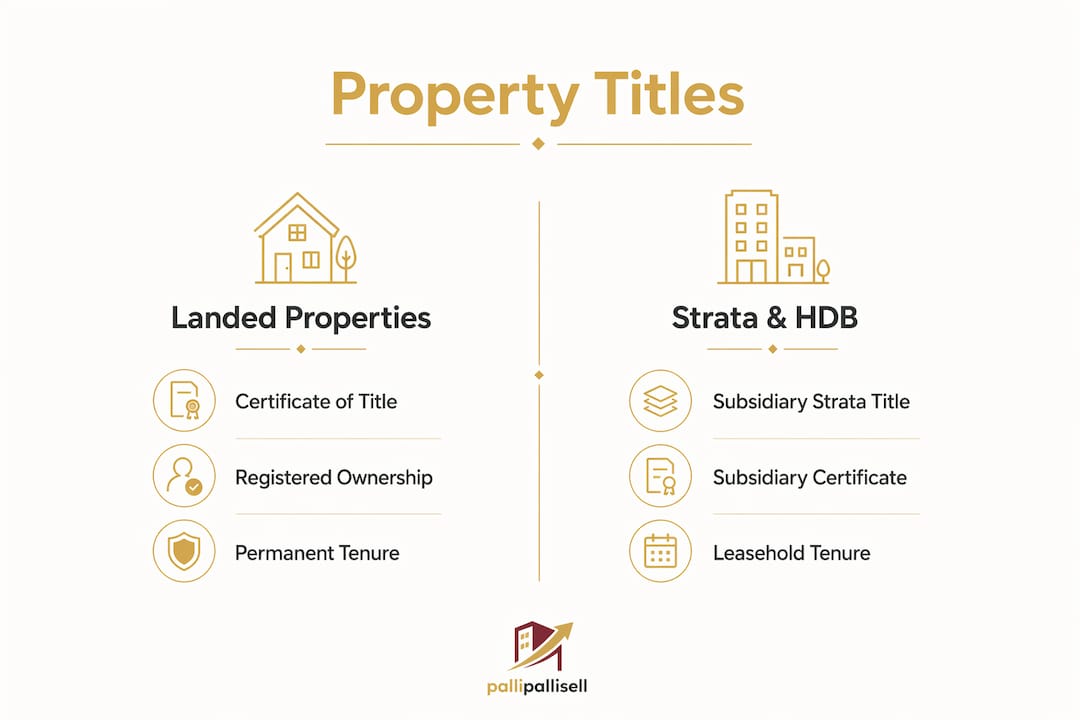
Different titles correspond to different property types, and this distinction affects ownership rights, document formats, and transfer procedures. Singapore uses three main categories of property title documents.
Title Type | Property Type | Key Characteristic |
Certificate of Title (CT) | Landed properties | Covers the land and all structures on it |
Subsidiary Strata Certificate of Title (SSCT) | Condos and apartments | Includes share of common property |
Subsidiary Certificate of Title (SCT) | HDB flats | Issued under HDB’s leasehold framework |
Certificate of Title applies to landed properties such as terrace houses, semi-detached homes, and bungalows. It covers the land parcel itself and everything built on it. The owner holds full rights over the land within the boundaries described in the title.
Subsidiary Strata Certificates of Title are issued for units in strata-titled buildings, which include most private condominiums and apartments. This form of title includes shared ownership of common property elements such as lobbies, pools, and corridors. Your individual unit is yours, but the shared spaces are co-owned by all unit holders in the development. For first-time condo buyers, understanding this distinction matters before you sign anything. A first-time buyer’s guide to Singapore condos can help you understand how strata ownership works in practice.
Subsidiary Certificate of Title applies to HDB flats. These are issued under HDB’s leasehold framework, typically for 99-year leases. The title confirms your right to occupy and sell the flat within HDB’s rules, but the land itself remains state-owned.
Pro Tip: Always confirm which title type applies to your property before starting any sale or purchase. The title type determines which laws govern your transaction and which documents your conveyancer will need.
How does Singapore’s Torrens system govern property titles?
Singapore’s property registration operates under the Torrens system, a model of land registration that makes the register itself the definitive proof of ownership. The Land Titles Act 1993 and the Land Titles (Strata) Act 1967 govern registration and regulation of titles for landed and strata properties respectively. These laws create the legal framework for all registered land and strata subdivision titles in Singapore.
The core principle of the Torrens system is indefeasibility. The registered proprietor holds legal title that is conclusive evidence of ownership under the Land Titles Act, except in cases of fraud. This means that once your name is on the SLA register, your ownership is legally protected against almost all competing claims.
Here is why this matters for buyers and sellers:
Legal ownership vests only on registration. Signing a sale and purchase agreement does not make you the legal owner. Only registration of the transfer instrument with SLA does.
The register is the source of truth. Buyers and lenders rely on the SLA register, not on contracts or promises, to confirm who legally owns a property.
Fraud is the primary exception. If a title was obtained through fraud, it can be challenged. Outside of fraud, a registered title is virtually unassailable.
Equitable interest precedes legal ownership. Before registration, a buyer holds only an equitable interest from the sale contract. The seller remains the legal owner until registration is complete.
“The registered proprietor’s title is conclusive of ownership and relied upon by buyers and lenders, reducing dependency on the sale contract. This legal certainty underpins market confidence in property transactions in Singapore.” — ICLG Real Estate Laws and Regulations Report 2026 Singapore
The Torrens system is what makes Singapore’s property market one of the most legally secure in Asia. When you buy a property here, you are not just trusting the seller’s word. You are trusting a government-maintained register that carries the full force of law. Understanding freehold vs leasehold tenure is equally important, since tenure type affects what your title actually grants you over time.
How is property ownership transferred and registered in Singapore?
The transfer of property title in Singapore follows a clear sequence. Knowing each step protects you from assuming you own something before you legally do.
Sign the Option to Purchase (OTP). The seller grants the buyer an option to purchase the property. No ownership changes at this point.
Exercise the OTP and sign the Sale and Purchase Agreement (SPA). The buyer commits to the purchase. The buyer now has an equitable interest, but the seller is still the legal owner.
Engage a conveyancer. Both parties appoint lawyers to handle the legal transfer. Your conveyancer prepares the transfer instrument and conducts title searches.
Conduct a title search. Your lawyer checks the SLA register for encumbrances, caveats, mortgages, or restrictions on the property.
Complete the transaction. The buyer pays the balance purchase price. The seller hands over vacant possession.
Register the transfer instrument with SLA. This is the critical step. Legal ownership passes upon registration of the executed transfer document with SLA. Not before.
Receive the updated title. SLA updates the register to reflect the new owner. If the original title is lost or the property was subdivided, SLA issues a replacement or new certificate.
The SLA issues Certificates of Title automatically when state land is sold and updated certificates when land is subdivided, amalgamated, or originals are lost. You do not need to apply for the initial certificate, but you can request a replacement if your original is lost, destroyed, or wrongfully withheld.
Pro Tip: Do not assume the deal is done at completion. Confirm with your conveyancer that the transfer instrument has been lodged and registered with SLA. Until that registration is confirmed, you hold equitable interest only, not legal title.
For sellers managing their own transactions, understanding the FSBO property sale process in Singapore is a practical starting point before engaging a conveyancer.
How can you check and verify your property title in Singapore?
Verifying your property title is straightforward using SLA’s digital tools. Singapore property owners can access title deeds digitally through the SLA MyProperty and INLIS portals for verification or to download copies. These online services reduce reliance on physical documents and give you accurate, up-to-date title information at any time.
Here is what you can do through these platforms:
View registered ownership details. Confirm who is listed as the legal owner on the SLA register.
Check for encumbrances. Identify any mortgages, caveats, or restrictions registered against the property.
Download a digital copy of your title. Useful for conveyancing, refinancing, or personal records.
Verify the title type. Confirm whether your property holds a Certificate of Title, Subsidiary Strata Certificate of Title, or Subsidiary Certificate of Title.
Request a replacement title. If your physical document is lost or withheld, apply through SLA for a replacement certificate.
Buyers should always run a title search before committing to a purchase. Sellers benefit from checking their own title early to identify any encumbrances that need to be discharged before the sale completes. Knowing about a hidden fee or encumbrance before listing your property saves significant time and avoids last-minute surprises at closing.
Key takeaways
Legal ownership of a Singapore property vests only upon registration of the transfer instrument with the Singapore Land Authority, not upon signing the sale contract.
Point | Details |
Property title defined | A title deed records ownership, tenure, registered owners, and encumbrances on a specific property. |
Three title types | Certificate of Title, Subsidiary Strata Certificate of Title, and Subsidiary Certificate of Title apply to different property categories. |
Torrens system protection | Registered title is conclusive proof of ownership and legally indefeasible except in cases of fraud. |
Registration is ownership | Legal title transfers only when SLA registers the executed transfer instrument, not at contract signing. |
Verify digitally | Use SLA MyProperty and INLIS to check ownership details, encumbrances, and download title copies. |
Why most buyers get the ownership timing wrong
I have seen this mistake more times than I can count. A buyer signs the sale and purchase agreement, pays the deposit, and starts telling friends they own the property. They do not. Not yet. Lawyers emphasize confirming registration status and executed transfer instruments in the SLA register at completion, because mere contract signatures do not transfer legal ownership.
The gap between signing and registration is where risk lives. During that window, the seller is still the legal owner. If something goes wrong, a buyer with only equitable interest has a harder legal fight than a registered proprietor. A buyer’s equitable interest before registration differs legally from the registered proprietor’s legal estate, and that difference affects enforceability in ways most buyers never consider.
My advice: treat registration confirmation as the real completion milestone. Ask your conveyancer for written confirmation that the transfer has been lodged and registered with SLA. Do not pop the champagne until that message arrives.
The digital tools available today, specifically SLA MyProperty and INLIS, make this verification fast and free. There is no excuse for not checking. Transparency in Singapore’s property system is genuinely excellent. Use it.
— Brandon
Ready to sell your property without the heavy fees?
Understanding your property title is the first step. The next step is deciding how to sell without losing tens of thousands of dollars in agent commissions.
Pallipallisell makes that decision easy. The platform charges a fixed fee of $688 instead of the 1% to 2% commissions traditional agents charge. You list your property, communicate directly with buyers, negotiate on your terms, and close the deal with full control. Whether you own an HDB flat or a private condo, Pallipallisell handles the process without the markup. Check the affordable selling fees to see exactly what you pay. If you own an HDB flat and want to move fast, the HDB sale without agent option walks you through every step from title check to completion.
FAQ
What is a property title in Singapore?
A property title in Singapore is the legal document issued and maintained by the Singapore Land Authority that records ownership, property description, tenure, registered owners, and any encumbrances on a specific property.
What are the three types of property title documents in Singapore?
The three types are the Certificate of Title for landed properties, the Subsidiary Strata Certificate of Title for condominiums and apartments, and the Subsidiary Certificate of Title for HDB flats.
When does legal ownership transfer in a Singapore property sale?
Legal ownership transfers only when the executed transfer instrument is registered with the Singapore Land Authority. Signing the sale and purchase agreement gives the buyer equitable interest only, not legal title.
How do I check my property title in Singapore?
You can check your property title through SLA’s MyProperty portal or the INLIS system, where you can view ownership details, check for encumbrances, and download a digital copy of your title document.
Can I get a replacement title if my original is lost?
Yes. The Singapore Land Authority issues replacement Certificates of Title when originals are lost, destroyed, or wrongfully withheld. You do not need the original to apply for a replacement.
Recommended


Comments